
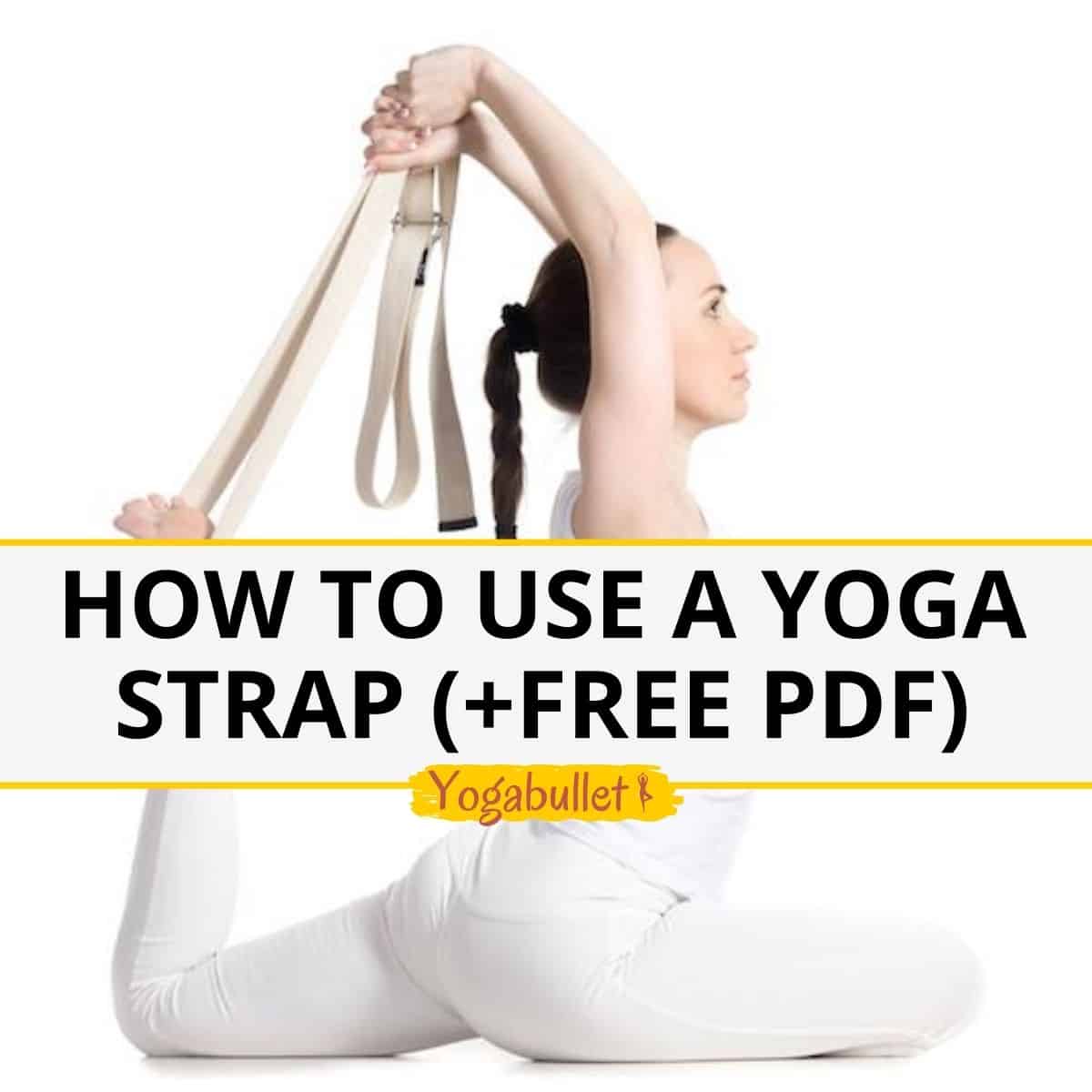
Yoga straps or yoga belts are one of the most popular yoga props. And they can seriously improve your yoga practice, too. Yet, for a beginner, there are lots of questions about them. Do you have to have one? What do you actually use it for? How to use yoga straps efficiently? And what is the best yoga strap for you?
Don’t worry, you’ll find answers to all of these questions here. And, as a bonus, you’ll even find a printable yoga strap stretches PDF below!
In this article:
- Benefits of yoga straps
- What is the best yoga strap?
- What length yoga strap to get
- 7 Yoga stretch strap exercises
- Printable Yoga strap stretches PDF
- Yoga strap alternatives
Disclosure: Some of the links below are so-called provision links, meaning, at no additional cost to you, I can earn a commission if you click through and make a purchase.
Still need to invest into a good yoga strap?
✅ This is the most popular, very affordable yoga belt for beginners!*
Do I need a yoga strap?
First, let’s get the basics out of the way? Do you need a yoga strap?
The short answer is, no, you can absolutely practice yoga without any props. Even if you are a super inflexible beginner, there are lots of modifications and easy poses you can practice.
Related: Yoga for the inflexible: 5 poses anyone can do
BUT: A yoga strap can absolutely speed up your process of becoming more flexible and learning new, advanced poses. The difference can be amazing! Additionally, there are some very targeted stretches for which you’ll definitely need a yoga belt because they were developed that way.
So let’s look at little more in detail at when to use a yoga strap and what it’s good for!
What is a yoga strap used for?

Like most yoga props, a yoga belt can help you get deeper into poses. In most cases, it does that by “making your arms longer”. (Obviously, it doesn’t really make your arms longer. It functions as an extension of your arms. You know what I mean!)
By doing this, it allows you to experience deeper stretches. And, as I said before, it also can make yoga poses accessible that you simply couldn’t practice before.
A yoga belt can also be used to maintain and correct your form, for example by wrapping it around your arms in chaturanga.
And, last but not least, you could use it to tie your mat and carry it around after your practice is done!
Benefits of yoga straps
So to summarise all the benefits of yoga straps:
- helps with alignment
- allows for deeper stretches with proper alignment
- makes advanced poses more accessible (in a safe way!)
- allows for playful variations of poses
- doubles as a yoga mat strap
What is the best yoga strap?
So now that you know how awesome a yoga strap will be for your practice, it’s time to get one. But what is the best yoga strap? How do you pick it?
No worries, I got you!
No time to read all the details and go through all of the best yoga straps?
✅ This is the most popular, very affordable yoga belt for beginners!*
Firstly, you want to make sure the belt fulfils the following criteria:
- firm fabric that doesn’t stretch (You’re supposed to stretch, not the strap!)
- material that won’t cause burns if you slip (ie cotton)
- material that’s not too slippery in case you sweat (also cotton)
Another thing you might want to consider is the buckle. Usually, you’ll have the choice between a normal buckle, a D-ring buckle, and no buckle/closure.
When it comes to buckles, there is no option that is per se better than the others. It really depends on what you personally like.
All three options will enable you to use the yoga strap as intended. So maybe go to some yoga classes in a studio and try out different straps there before deciding which one is the best strap for you!
What length yoga strap should I get?
One last thing to consider before we get to shopping your perfect yoga belt: the length! You want to make sure this fits your body height.
The standard length is 6 feet (about 183 cm), and it will fit most people’s needs. However, if you are taller, or want to try more than the standard “belt poses”, you might want to go a little longer.
Usually, you’ll have the option to choose 6 feet, 8 feet, or 10 feet in length. (That would be 183 cm, 244 cm, or 305 cm.)
How to choose length of yoga strap
To pick the right yoga belt length for your purposes, you need to take a look at two things:
- Look at your own height
Are you smaller than 5’6 (167 cm)? Then the 6-foot belt is enough for simple stretches.
Did you grow to more than 6 ft (183 cm)? Getting a 10-foot belt is your best option.
Everyone else finds their ideal size with the 8-foot yoga strap. - What’s your preference?
Even if you are on the shorter side, you might love experimenting with new poses. Like I said above, for some of them, you’ll simply need some more strap. Often you even have to double it.
If that sounds like you, you’ll want to pick the 8-foot strap, regardless of your height.
For me personally, having some more strap and flexibility to try all kinds of loops and poses outweighs the downside of a longer strap.
On the other hand, picking a longer strap also means you’ll have “dead” strap hanging around in poses where you don’t need it. It that’s a pet peeve of yours, definitely pick the shortest belt for your height.
This comes down to personal preference, there is no right or wrong here. Just keep in mind that you can always shorten your belt, but you can’t add length!
Hugger Mugger D-ring Yoga strap*


This top-grade yoga belt can deal with resistance of up to 500 pounds (about 227 kg). It’s made of dense cotton webbing, offering a good grip.
You can pick from 3 different lengths, all very affordable. Especially considering the top-notch quality!
Oh, and did I mention it comes with a lifetime warranty?
Order the Hugger Mugger yoga belt here!*
Manduka AligN Yoga Strap*

Manduka definitely knows how to make Yoga equipment! (They also have the best yoga mat, in my opinion!)
Related: How to find the best Yoga mat
Manduka’s AligN yoga strap is a little wider than your usual yoga belt, which many people prefer. This can make poses easier to get into and hold, especially for beginners.
The strap is made out of a pretty stiff cotton webbing and it comes with a lockable, adjustable buckle.
If you like good quality, and want to buy a yoga strap that will last you forever, the Manduka AligN is a great choice!
Order the Manduka Align Yoga Strap here!*
Gaiam Yoga straps*

The Gaiam yoga straps are made of 100% very durable cotton. If you like a heavy-duty yoga belt, this one will do the trick.
And the best thing about these? You can machine wash them. Perfect for the lazy yogi!
Order a Gaiam yoga strap here!*
7 Yoga stretch strap exercises
So now that you know what yoga belt to get, it’s time to get into how to use a yoga belt!
(While you can also use it to improve your alignment, I’ll mostly focus on stretching with a yoga belt here.)
Let’s look at a few yoga strap exercises!
(And yes, most of these yoga strap poses are perfectly suited for beginners.)
Yoga strap hamstring stretch
Probably the most common way to use a yoga belt is for hamstring stretches. For most people, especially inflexible beginners, touching your feet is quite literally out of reach. At the same time, doing those hamstring stretches is the only way to get there over time.
Yoga straps are the perfect way to do hamstring stretches with good form, even if you’re not that flexible yet.
1. Seated yoga strap hamstring stretch

Paschimottanasana or the seated forward fold is a very popular hamstring stretch. To put the stretch really on your hamstring and not on your lower back, it is super important to keep your back straight in this asana.
For most of us, this means, we cannot grab our feet. So instead, wrap your yoga strap around your feet and grab an end of the strap in each hand while maintaining good posture in your upper body.
Make sure to relax your shoulders, you don’t want them to hunch forward either!
With time, you’ll release your tight hamstrings towards a deeper forward bend!
Want to get more flexible for yoga the easy way? Check out the 14-day Toe touching challenge! It helps you touch your toes in 10 minutes a day or less.
2. Reclining hand-to-big-toe pose

Reclining hand-to-big-toe pose is an amazing stretch to increase your hamstring flexibility! It allows you to relax and focus on the stretch.
Simply lay down flat on the floor, anchoring through your shoulders, hips, and feet. Then lift one leg up, let’s say the right one, while keeping your hips leveled.
Wrap your strap around the right foot and grab the other end with your hands. Make sure to keep your shoulders on the floor!
Now gently pull your foot towards the floor, all while keeping a straight back.
If you feel your lower back rounding against the floor, simply bend your other leg and plant the foot down, rather than keeping it stretched out.
There’s a reason that this one is possibly the most popular of yoga belt exercises: it is relaxing and yet incredibly effective at opening up your hamstrings!
3. Standing yoga strap hamstring stretch

If you’re feeling more active, and want to work on your balance while stretching out your hamstrings at the same time, try extended Hand-to-Big-Toe Pose with a strap!
(Also called Utthita Hasta Padangusthasana.)
You’ll need quite a bit of focus to make this happen. It’s definitely a more difficult pose. But don’t worry, toppling over happens to all of us and it’s part of the fun.
Make sure to stand up tall, keeping your back straight and your lower belly muscles tucked in. Then lift one foot up, so that you can wrap your strap around it.
Keep both ends of the strap in the same hand.
From here, slowly stretch it forward until your leg is parallel to the floor. You can use your other arm to help you balance. (See the picture above.)
This is not necessarily the best of beginner yoga strap poses – if you’re still working on basic hamstring opening, start out with the two yoga strap poses above!
Yoga strap stretches for shoulders
Are your hamstrings already relaxed and open? Then it’s time to look at how to use a yoga strap to open up tight shoulders!
Especially for those of us who sit at a desk all day long, the help of a yoga belt is more than welcome for many shoulders openers. And it’s super efficient, too!
Simply pick one of the following shoulders stretches with yoga strap and do it daily for a week: You’ll already notice a clear difference in your upper back and chest!
4. Shoulders moving over with strap
A super easy shoulder stretch you can do with your yoga strap is this one:
Simply grab your yoga belt with both hands in front of you. Your hands should be wider than shoulder-width apart. The wider the distance between your hands, the easier the stretch. So start rather wide, you can still go closer later!
Now keep some tension between your hands, and move the strap up and over your head. Move it as far down your back as you can while keeping your arms straight.
Repeat a few times!
5. Hands grabbing behind your back

This shoulder stretch is usually a part of cow face pose. For our purpose now, we’ll focus on the upper body and shoulders only though.
I’ve always been impressed by people who could simply grab their hands behind their back like that. For me and many others, this feat is only doable with the help of a yoga strap. And even then, it’s quite and intense shoulder stretch!
To get started, grab your strap with your right hand and stretch your right arm straight up above your head. From there, bend your right elbow and let the hand sink down along your back. (The right elbow keeps pointing straight up, though!)
Your palm should be facing your back. Let the strap hang down loosely.
Now straighten your left arm, rotate it backwards slightly and move your left hand up on your back. The palm should be facing outwards and the back of the hand towards your back.
Move it up as far as you can and then grab the strap. For me, this is quite intense, and I usually just hold it for a few breaths before repeating it on the other side.
Over time, this will increase your shoulder’s range of motion significantly!
6. King pigeon pose

If you want to try something more advanced with your yoga strap, king pigeon pose is a great choice!
For that, you come into a “normal” pigeon pose which is already a great stretch for tight hips.
Then wrap your yoga belt around your back foot. At this point, you still want to have your hands behind your back, to be able to grab the strap properly.
Then bend your back leg, all while moving your elbows out and then up. Once your arms are over your head, you can enjoy the back and forth between your back leg and your shoulders.
Make sure to keep your lower belly muscles engaged, and to straighten your spine as much as possible. Be mindful to not compress the low back.
In general, do this slowly and carefully, you’ll always want to be cautious with shoulder stretches! Use the strap for all the extra length you need.
Once you’ve mastered this seated backbend with a stretch, you could even try dancer’s pose. But be warned: the risk of injury with that one is much higher when a strap is involved!
7. How to use a yoga strap for posture
Last but not least, you can also use your yoga strap to improve your posture! (And at the same time get an amazing, passive Yoga strap neck stretch!)
Take the belt on your back, parallel to the floor, and directly under the shoulder blades. Then you take both sides of the strap forward under your armpits and lay them over your shoulders.
Now you cross the yoga belt ends behind your back, so it looks like an X. Lastly, pull the ends forward again, and close the belt in front of your body.
Pull it tight enough so that you feel it pulling back your shoulders and lifting your chest. But, of course, not so tight that it hurts or makes breathing hard!
This video below explains the process very well, if you’d prefer some visual guidance!
Related: Get it straight: 7 Yoga poses to improve your posture
Yoga strap stretches PDF
Are you super inspired now and want to make the best use possible of your yoga strap? Then download this printable PDF with a collection of yoga strap stretches to properly use this great tool!
Simply click on the image below and your PDF will open in a new tab.

What can I use instead of a yoga strap?
If you just want to simply try out these stretches with a yoga strap, you might not have a strap at home yet. In that case, you can choose a yoga belt alternative from the list below:
- Towel: make sure it’s long enough!
- Scarf: needs to be “stable” enough, don’t use a fabric that tears easily.
- Belt: usually very durable, be careful to not hurt yourself on the belt-buckle
- (Bath-) robe tie: only for poses where you don’t put too much strain on it
Related: I can’t do butterfly stretch – What now?
Related: What to use instead of Yoga blocks: 7 alternatives
To simply try things out and get a general idea, these alternatives can work. Nevertheless, none of them work as well as the real thing. Think of those poses where you really need the whole functionality of a yoga belt. For example, those poses where you need to put some weight on it and where you need to buckle your yoga strap.
For the long term, I definitely recommend investing in a “proper” yoga strap. It won’t set you back that much, most yoga belts are very affordable. It will open up lots of new possibilities in your practice. And, honestly, it’s simply fun to play with!

*These links are so-called provision links, meaning, at no additional cost to you, I can earn a commission if you click through and make a purchase.
Hi, I’m Leo, the Yogi behind Yogabullet. I’ve been practicing Yoga for over 10 years now.
My goal with this blog is to show people how Yoga can help anyone, no matter how fit they are, to love their body and their life more.
I’ve experienced the life-changing power of Yoga myself and made it my mission to share this with as many people as possible.
I am a Registered Yoga Teacher (RYT) with Yoga Alliance, which acknowledges the completion of a yoga teacher training with a Registered Yoga School (RYS).